
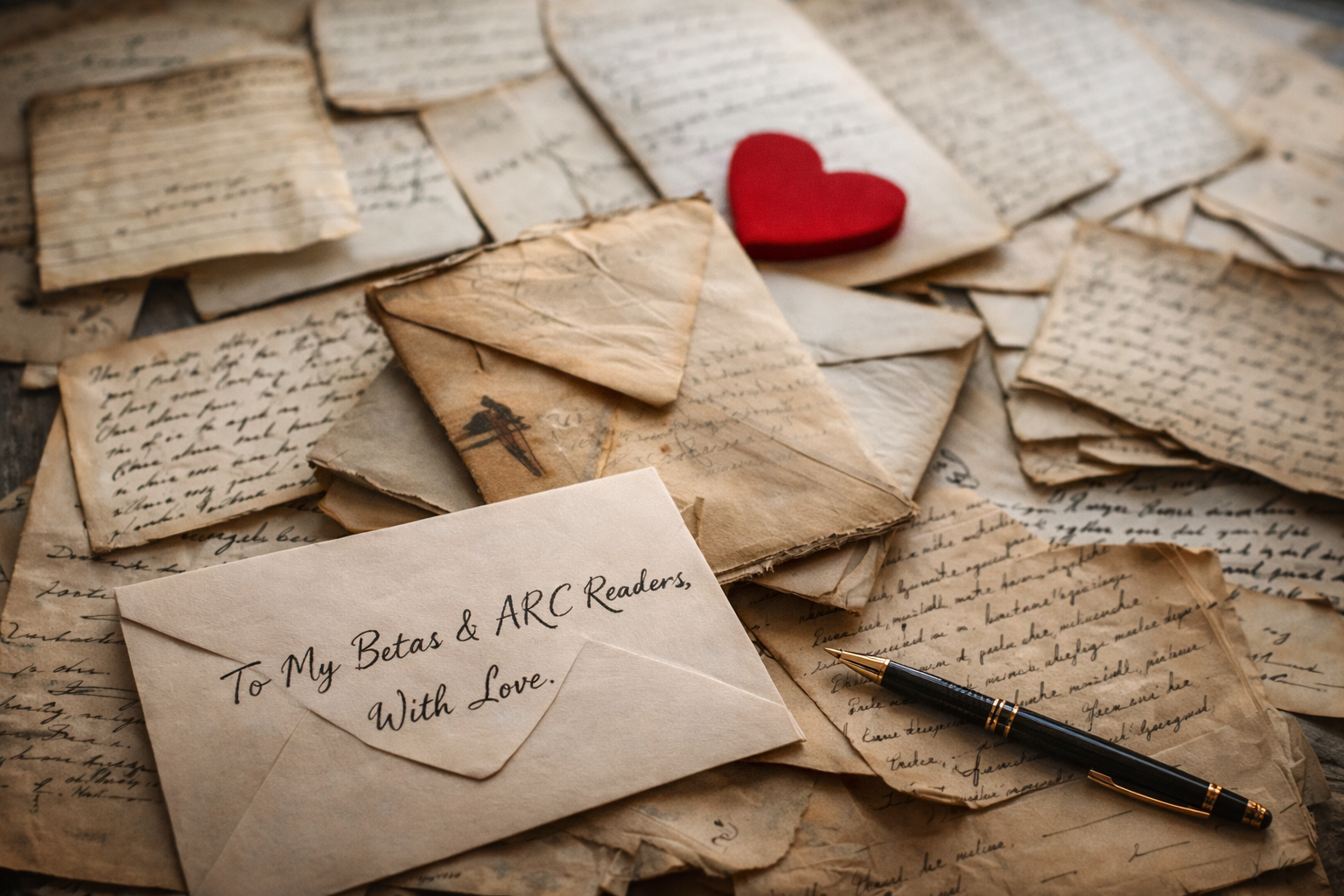
Before Release Day, Thank You
There is something deeply vulnerable about letting people read your work before it belongs to the world.
Before the launch graphics. Before the polished posts. Before release day turns everything into countdowns, links, and numbers. There is just the story, sitting there in your hands, still warm from your own heart, and the quiet hope that when you pass it to someone else, they will hold it with care.
That is what my beta readers and ARC readers have done for Mad Love.
They held it first.
And before this book officially makes its way into the world, I wanted to take a moment to say thank you.
Thank you to the beta readers who met this story in its earlier forms. Thank you for reading so thoughtfully, for catching things I couldn’t see anymore, for telling me where the emotion landed, where the characters stayed with you, where you laughed, where you hurt, where you wanted more. Thank you for helping me make this book stronger without ever making me feel smaller.
Thank you to my ARC readers who stepped in during this tender pre-release season and gave this story your time, your energy, your honesty, and your heart. Thank you for the early reviews, the kind messages, the screenshots, the reactions, the favorite lines, and the reminders that this story was reaching people in the ways I had hoped it might.
Indie publishing is a beautiful thing, but it is also personal in a way that is hard to explain unless you’ve lived it.
There is no giant machine buffering the emotional risk. No glossy wall between the writer and the work. You write the book, yes, but then you also carry it. You revise it, shape it, prepare it, talk about it, post it, package it, and slowly place it into other people’s hands while trying not to completely unravel in the process. It asks you to be creative and brave at the same time. To believe in the work while it is still becoming real to everyone else.
That is why early readers matter so much.
You are the first echo.
You are the first proof that the story has a pulse outside of me.
Before release day arrives, before strangers stumble across it, before it finds its wider audience, there are always those first readers who say: I see what you were trying to do here. I’m with you. Keep going.
That kind of support means more than I can probably put into one blog post.
So to everyone who read Mad Love early, thank you. Thank you for your honesty. Thank you for your encouragement. Thank you for your patience with an indie author building the plane and flying it at the same time. Thank you for helping me feel less alone in this process. Thank you for meeting Harlee and August with open hearts. Thank you for making this release season feel not just nerve-wracking, but meaningful.
A book may begin with the writer, but it becomes something fuller when readers step inside it.
And I am so grateful for the readers who stepped inside this one early.
You helped me carry this story to the finish line.
You helped me believe in it a little more on the days when launch nerves were loud.
You helped Mad Love become real before the rest of the world ever touched it.
I will never take that lightly.
So this is my little corner of the internet saying what I hope you already know: I appreciate you. Deeply. Truly. More than these words can hold.
Thank you for reading Mad Love first.

The Road To Love Usually Has Potholes
There is something almost absurd about writing romance when your own heart feels tender.
Not broken in the dramatic, movie-montage sense. Not always. But bruised. Questioning. Tired. A little too aware of how fragile people can be with each other. A little too aware that love, no matter how beautiful, is never simple once it enters a real life.
And yet, that’s where I keep writing from.
From the ache. From the hope. From the part of me that still believes big love is worth reaching for, even when life has given me every reason to be more cautious with the way I dream.
I think people assume writing romance means living inside fantasy all the time. Candlelight, playlists, pretty scenes, yearning dialogue, and emotionally devastating men with strong hands and communication issues. And yes, sometimes it is that. God bless. But writing love stories, at least for me, has never been about escaping reality completely. It’s been about making meaning out of it.
It’s been about asking harder questions.
What does love look like when you’ve been disappointed? What does desire look like when you are still healing? What does softness mean when the world keeps rewarding your armor? What does it mean to believe in connection when you know firsthand that chemistry is not the same thing as care?
Those are the questions that live underneath my stories. The pretty lines may get all dressed up and go outside, but underneath them is a woman trying to understand what it means to love deeply without disappearing into it.
That’s part of why I write the women I write.
They are rarely perfect. They are often emotionally intelligent and still a little self-destructive. They are ambitious, sensual, funny, guarded, longing, and still figuring it out in real time. They know how to survive. What they’re learning, slowly, is how to receive. How to trust. How to stop mistaking chaos for passion and self-abandonment for devotion.
To be honest, that kind of writing only gets more vulnerable when real life is already pulling on your heart.
Because then every love scene, every argument, every tender realization asks something of you too. It asks you what you still believe. It asks whether you’re cynical or just scared. It asks whether you still have enough hope in you to write toward intimacy instead of away from it.
Some days, that feels easy. Some days, it feels like dragging silk through gravel.
And then there’s the indie author side of it all, which is its own beautifully unhinged experience.
Because now it’s not just about writing the book. It’s about living with the book in public.
It’s about trying to create something honest and emotionally textured while also remembering to post the teaser, make the reel, update the website, format the newsletter, check the preorder link, tweak the metadata, build the ARC plan, choose the song, make the graphic, and somehow still protect the soft animal part of yourself that writes from feeling instead of performance.
That’s the strange tension of being an indie author right now. There are so many media avenues. So many ways to be visible. So many platforms asking you to turn your creative life into a steady stream of content. And while I’m grateful for the access, truly, it can also start to feel like the story is no longer enough on its own. Like writing the book is only one part of the job, and maybe not even the loudest part.
But for me, it still has to be the center.
The writing has to stay holy.
Because without that, all the rest of it becomes noise. Pretty noise, branded noise, strategic noise, but noise all the same.
I never want to get so caught up in “being an author online” that I lose touch with why I became one in the first place. I did not come here just to make content. I came here to tell stories. To write women who feel real. To create the kind of romance that leaves a bruise and a balm. To make space for Black women to be desired, complicated, softened, protected, and deeply seen without having to flatten themselves first.
That is the work.
The rest of it, the marketing and visibility and launch-day logistics, matters. It does. Especially as an indie. But it cannot be the whole thing. It cannot be the altar.
So maybe that’s what this season is teaching me.
How to hold both.
How to be vulnerable without being consumed by visibility. How to keep writing big passion without pretending my heart is untouched by real life. How to believe in romance without making it dishonest. How to be an indie author in a world full of platforms and pressure and still keep one hand on the reason I started.
I think that’s what readers connect to anyway. Not perfection. Not polish with nothing beating underneath it. Real feeling. Real tension. Real hope.
Because maybe the truth is, the best love stories are not written by people who have everything figured out. Maybe they’re written by people who are still trying to understand love well enough to tell the truth about it.
And that’s where I am.
Still believing in big love. Still writing toward tenderness. Still trying to make something beautiful out of heartbreak, noise, longing, hope, and all the messy little feelings in between.
Maybe that’s what being an indie author is right now.
Not just writing the story. Protecting it.
Have you ever had to create something beautiful while living through something tender? Tell me in the comments. I’d love to know what you made, or what kept you going.

What I Learned Writing My First Novel
Spoiler: it wasn’t about the book. It was about me.
There is something a little unwell, a little holy, and a little hilarious about deciding you are going to write a novel.
Not think about it. Not romanticize it. Not tell yourself you’ll get to it “when life calms down.” Actually write it. Finish it. Revise it. Stay with it long enough to make it real.
And now here I am, less than twenty days away from releasing my first novel, Mad Love, still trying to find language big enough for what that process has taught me.
Because the truth is, writing my first book taught me a lot about craft. It taught me discipline. It taught me structure, pacing, restraint, and when to cut the line I loved because the story deserved better. It taught me how to hear when a scene was lying. It taught me when a character was protecting themselves and when I was protecting myself through them.
But the biggest lesson had very little to do with the book itself.
Writing Mad Love taught me how to trust my own voice.
And I don’t mean that in a cute, inspirational Pinterest quote kind of way. I mean really trust it. Trust that the stories I want to tell matter. Trust that the women I center deserve to take up space on the page without apology. Trust that softness, sensuality, emotional complexity, and Black womanhood do not need to be flattened, overexplained, or made more “universal” to be worthy of attention.
That kind of trust did not arrive all at once.
It came through doubt. Through messy drafts. Through opening a document and hating everything I wrote the day before. Through revising scenes until they finally sounded like me instead of sounding like what I thought a “real author” was supposed to sound like. Through realizing that every time I watered myself down, the writing suffered for it.
That was one of the first big lessons: the page knows when you’re hiding.
It knows when you’re being careful instead of honest. It knows when you’re choosing polish over truth. It knows when you’re reaching for what sounds impressive instead of what feels real.
And Mad Love forced me to stop doing that.
This book asked me to be braver than I expected. Not because it was the hardest story ever written. Not because every chapter came from some dramatic place of suffering. But because writing a book means staying in relationship with your own imagination long enough to see what keeps coming back. What themes keep following you. What emotional truths you can’t seem to leave alone.
For me, that meant returning again and again to women who are trying to hold it together while quietly coming undone. Women who are smart, capable, and self-aware, but still vulnerable to longing. Women learning that love is not the same thing as self-abandonment. Women discovering that being chosen means very little if they have not chosen themselves.
Apparently, I had a few things to say.
Another thing I learned? Finishing is its own kind of miracle.
People talk a lot about starting. Starting is sexy. Starting gets the dramatic montage. Starting is all candles, playlists, and “this could be something.” But finishing? Finishing is where the real character development lives. Finishing is what happens when the novelty wears off and the work asks whether you meant it.
There were so many moments when I could have drifted away from this book. So many moments when life was loud, when the draft felt impossible, when my own expectations got in the way, when the gap between the story in my head and the story on the page made me want to close the laptop and go be fake productive instead.
But I kept coming back.
Not perfectly. Not always gracefully. But faithfully.
And that taught me something too.
I learned that discipline is not always rigid. Sometimes discipline looks soft. Sometimes it looks like returning. Like trusting that even if today’s work is awkward or thin or clumsy, it still counts. Sometimes it looks like writing one paragraph and protecting that paragraph like it matters. Because it does.
I also learned that revision is not punishment.
Revision is where the magic stops flirting and finally commits.
It is where I learned to listen harder. To trim what was repetitive. To deepen what was true. To stop asking scenes to perform and let them breathe instead. Revision taught me that sometimes the most powerful sentence is not the cleverest one, but the clearest. Not the loudest, but the one that lands clean and honest.
It also taught me humility, because nothing humbles you quite like realizing the chapter you thought was done is, in fact, wearing a cute outfit and absolutely not ready to leave the house.
Then there was the fear.
Let’s talk about the fear, because she had opinions.
Fear showed up in all the predictable ways. Fear of not being good enough. Fear of being too much. Fear of being misunderstood. Fear of putting something personal into the world and having it met with indifference. Fear of wanting this deeply and having to admit that I wanted it deeply.
That part is important.
Because sometimes the scariest thing is not failure. Sometimes it is sincerity. Sometimes it is wanting something enough that it could break your heart a little. Sometimes it is saying, “I made this. It matters to me. I hope it finds you.”
There is nowhere to hide in that.
And maybe that is why I’m proud of this book beyond the pages themselves. Not just because I wrote it, but because I stayed emotionally available enough to finish it. I let it change me. I let it sharpen me. I let it reveal where I was still playing small.
So what did I learn writing my first novel?
I learned that voice is not something you invent. It is something you uncover by telling the truth often enough.
I learned that the women I want to write about, the ones who are figuring it out in real time, deserve stories that hold them with care.
I learned that beautiful sentences are lovely, but emotional honesty is what makes people stay.
I learned that perfection is a moving target with terrible communication skills.
I learned that creative work will ask for your courage long before it rewards your confidence.
And I learned that writing is not just storytelling. It is self-trust in motion.
It is choosing, over and over again, to believe that what lives in you is worth shaping. Worth refining. Worth finishing. Worth sharing.
Mad Love taught me that.
It taught me that I do not need to wait until I feel fearless to call myself a writer. I do not need to have every answer before I take myself seriously. I do not need to become some shinier, bolder, more impressive version of myself before I deserve to make art.
I just need to keep showing up honestly.
That’s the lesson I’m carrying with me into launch.
Not that I made a perfect book. But that I made a real one.
And for a first novel, for this season, for this version of me, that feels like everything.
If you are reading this while holding a dream that scares you a little, maybe a lot, consider this your sign to start anyway. Start messy. Start unsure. Start before you feel fully ready. The clarity does not always come first. Sometimes it meets you in motion.
Sometimes the becoming is the point.
And maybe that’s what writing my first novel really taught me.
Not just how to finish a book.
How to trust the woman finishing it.
If you’re chasing a dream that scares you, consider this your sign to start anyway.
And if there’s something you’re building, writing, or quietly hoping to become, tell me in the comments. I’m rooting for you.

Becoming, Softly
I don’t write perfect women. I write the ones figuring it out.
Growing up, I was always looking for women on the page who felt like the women I knew in real life. Not just beautiful. Not just strong. Not just the best friend with the one-liners or the girl who held everything together while everyone else got to unravel. I wanted women who were messy and magnetic. Women who were smart, sensual, ambitious, soft, defensive, funny, healing, and sometimes absolutely one bad decision away from a spiral. I wanted Black women who got to be the center of the story without having to earn it through suffering or explain every layer of themselves to be understood.
I was missing women who felt familiar to me. Women who could be deeply loved and deeply complicated at the same time. Women who could want more. Women who could be cared for without losing their edge. Women who didn’t have to choose between softness and self-respect, between desire and dignity, between ambition and tenderness. So when I started writing, I think I was really trying to write my way back to them.
In my worlds, softness does not mean weakness. Softness looks like honesty. It looks like letting someone see you before you feel fully polished. It looks like saying “that hurt me” instead of pretending it didn’t. It looks like rest. It looks like pleasure without guilt. It looks like receiving love without immediately looking for the catch. Softness is a woman choosing not to perform hardness just because the world expects it from her.
And strength? Strength is not just survival. It is not always the loudest thing in the room. Sometimes strength looks like restraint. Sometimes it looks like boundaries. Sometimes it looks like a woman breaking a pattern that has kept her safe but lonely. Sometimes it looks like leaving. Sometimes it looks like staying and telling the truth. Sometimes it looks like being brave enough to want something gentle after a lifetime of mistaking chaos for chemistry.
One of the things I love most about writing is when a character surprises me. Not by doing something dramatic, but by choosing healing when chaos would have been easier. Those are my favorite moments. The quiet ones. The moments where a woman who has every reason to run decides to pause instead. Where she speaks up. Where she asks for what she needs. Where she resists the old instinct to self-sabotage. Where she lets love be additive instead of transactional. Those choices are never flashy on paper, but emotionally? They shake the room.
That’s the kind of arc I’m always chasing. Not perfection. Not a makeover montage disguised as growth. Real change. The kind that is slow and uneven and a little terrifying because it asks you to become someone new while still carrying every version of yourself that came before.
When I write Black women, I’m not interested in shrinking them into symbols. I don’t want them flattened into “strong Black woman” shorthand or dressed up as lessons for other people. I want them to be whole. I want them to be allowed the same contradictions, softness, sensuality, ambition, selfishness, humor, grief, vanity, brilliance, confusion, and grace that everyone else has always been given on the page. I center their complexity by treating it as a given. Not a thesis. Not a lecture. Just truth.
That matters to me deeply.
Our interior lives deserve detail. Our tenderness deserves language. Our desire deserves care. Our healing deserves time. And our stories deserve to exist without pausing every five minutes to explain why we’re human.
That care shows up in the craft for me, too. I think a lot about what intimacy means on the page beyond whether a scene is “spicy.” I care about consent that feels clear and rooted in character, not clinical. I care about aftercare. I care about body language and hesitation and check-ins and the quiet emotional math people are doing when they want to be loved well. I care about boundaries language because I think there is something powerful about watching a woman name what she wants, what she doesn’t, and what she will no longer settle for. Even in the mess. Especially in the mess.
I love romance because it gives us space to explore all of that through connection. One of my favorite tropes will always be the woman who looks like she has it handled meeting the kind of love that doesn’t try to conquer her, only meet her where she is. I love desire with depth. Chemistry with consequences. Banter with emotional teeth. I love a love story where the real tension is not just “will they or won’t they,” but “can they become the version of themselves capable of receiving this?”
That is where I try to make it mine.
I’m always writing women in motion. Women in transition. Women at the edge of becoming. Women who are unlearning, relearning, falling apart, pulling themselves back together, and looking cute while doing it. Not because they are flawless. Because they are trying. Because they are worthy in the middle of it. Because becoming is holy work, even when it’s ugly, even when it’s slow, even when it doesn’t photograph well.
And maybe that’s really who I write for.
I write for the woman who has had to be practical for so long that softness feels suspicious. I write for the woman who knows how to get things done but is still learning how to be held. I write for the woman who has been misunderstood because she is both tender and sharp. I write for the woman who wants romance, but not at the cost of herself. I write for the woman who is tired of stories that confuse suffering with depth and chaos with passion. I write for the woman who is still figuring it out and secretly worried that everyone else already has.
Baby, they don’t.
None of us do.
We are all becoming.
And if my books do anything, I hope they remind you that your complexity does not make you hard to love. Your sensitivity is not a flaw. Your desire is not something to apologize for. Your healing does not have to be perfect to be real. You are allowed to be a masterpiece and a work in progress at the same time. You are allowed to be powerful and unsure. You are allowed to want softness without surrendering your standards. You are allowed to take your time becoming the woman you already feel stirring underneath the surface.
That woman is welcome here. She is who I write toward every time.
And maybe, in some quiet way, she’s who I write with too.
Which character, from any book, made you feel seen and why? Tell me in the comments. I’d love to know who stayed with you.

Before You Meet August and Harlee
There’s a moment before every love story begins.
The quiet second before the spark. Before the tension. Before two people who absolutely should not fall for each other realize they’re already in too deep.
That’s where Mad Love lives right now.
There’s a moment before every love story begins.
The quiet second before the spark. Before the tension. Before two people who absolutely should not fall for each other realize they’re already in too deep.
That’s where Mad Love lives right now.
Right on the edge of everything.
August and Harlee have been living in my head for a long time. Long enough that sometimes they feel less like characters and more like two stubborn people who refuse to stop arguing with each other until I get the story right.
And trust me, these two argue.
Harlee is the kind of woman who has always been capable of standing on her own. She’s ambitious, sharp, and just stubborn enough to push back when someone tries to tell her what her life should look like.
August, on the other hand, walks into a room like he already knows exactly what he’s doing there.
Confident. Charming. A little dangerous in ways that make people pay attention. The kind of man who understands the effect he has on people—and isn’t afraid to lean into it.
Naturally, putting those two people in the same orbit was never going to end quietly.
The chemistry between them is immediate. The kind that makes everyone else in the room feel like they’re interrupting something.
But Mad Love was never just about the spark between them.
It’s about what happens when two people who are used to being in control suddenly find themselves challenged by someone who sees right through them.
It’s about ambition. Growth. Boundaries. And the complicated reality that loving someone doesn’t mean you get to stop them from becoming who they’re meant to be.
I’ve always believed the best love stories aren’t about being rescued.
They’re about becoming.
Becoming braver. Becoming clearer. Becoming someone who can choose love without losing yourself in the process.
That’s the journey August and Harlee find themselves on.
And if I’ve done my job right, by the time you reach the end of their story you might find yourself asking a few questions of your own about love, ambition, and the choices we make when our lives start shifting underneath our feet.
For now, though, we’re still in that quiet moment before the story begins.
The moment right before everything changes.
As Mad Love gets closer to release, I’m opening a small number of Advance Reader Copies (ARCs) for early readers who want to step into the story before it officially launches.
If you enjoy:
messy, passionate love stories
ambitious heroines
powerful chemistry
and characters who feel a little too real
you might be exactly the kind of reader I’d love to have on this journey.
You can sign up for ARC opportunities through my reader list below.
I can’t wait for you to meet August and Harlee.
—From Karma, With Love

A Little Ditty About Mad Love
“I didn’t mean to write a book about falling apart — but that’s how all the best love stories start.”
I didn’t set out to become this author. I’ve been writing since I was a kid—wild little worlds that didn’t make sense and somehow meant everything. In fourth grade, I entered a school contest with a book about deforestation (tiny me saving the rainforest with a stapled spine and big feelings). That’s where I fell in love with storytelling: asking “what if,” poking holes, and making something honest out of a mess.
Mad Love started with a different kind of mess. Real life. The breakup you don’t post about. I wrote because my heart was loud and I needed somewhere to put it. The characters showed up first—half-whispers at 2 a.m., full conversations by sunrise. The heroine had been orbiting me for years, a woman who takes on more than she should and still finds a way to glow. The hero? He changed under my hands. He evolved from a man I couldn’t quite trust into a hero even I didn’t expect—steady where it counts, flawed where it matters, and somehow exactly the friction Harlee needed.
The question that wouldn’t stop knocking was stubborn and straightforward: What if two people mirrored everything I was learning about love, boundaries, and vulnerability—and still chose each other? What if they didn’t tidy themselves up first? What if love wasn’t a reward for perfection, but the catalyst for truth?
If I’m honest, the scariest part wasn’t writing the complex scenes—it was believing anyone would care. Is it good enough? Am I good enough? Hitting “save” is safe. Hitting “share” is a dare.
And the complex scenes were… complex. The ones that require you to bleed on purpose. I remember staring at the cursor the day I wrote the antagonist. I didn’t want to be the “bitter, man-hating” trope. I wanted to tell the truth. To show the subtle ways harm hides in charm; to climb inside the logic of a cheater, an abuser, a liar—and make it unmistakable without preaching. Writing that was ugly-beautiful. It felt like closure for every woman I love, for every version of me that swallowed red flags and called it romance. On the page, I had to ask myself out loud:
Why do I accept love I don’t deserve? Why do I believe words over patterns? Why do I choose the storm and then call it fate?
People always ask for a line I almost cut. Here’s the truth: it was never just one line. I am a lover of details. I write from both the 3,000-foot view and the 3-inch view, because life exists in both. Mad Love once ballooned past 500k words (I know. You’re welcome). I trimmed whole scenes I adored, paragraphs I wrote at 3 a.m. with tear-salty tea and a playlist on loop. But the reason I fight for detail is simple: our love lives are the journey, not the destination. If we all ended up with our first crush, we’d have no story—just a prologue.
Somewhere in the drafting, my ideas about love shifted. Boundaries stopped feeling like walls and started reading like invitations. Vulnerability became less about confession and more about clarity. And the tropes? They shapeshifted. This story began as a poem in a college workshop, flirted with self-help, wandered into discovery, and then landed on the idea of “having it all.” Because why can’t we have both—desire and peace, accountability and softness, a partner and our whole self?
If Mad Love were a feeling, it would be yellow.
A color that hums.
A scent like fresh, clean air after weeks of rain.
A temperature like sunlight on your cheeks in July—warm enough to make you close your eyes and remember yourself.
Writing this book didn’t fix me. It changed me. It made me braver about telling the truth and kinder about how long it can take to reveal the truth. Harlee and August are my “what if”—two people who learn to want boldly and choose carefully. Two people who don’t perform love; they practice it.
If you want to feel what I felt writing it, start here: Mad Love: The Soundtrack.
From Karma, with love. 💛

Welcome To The Madhouse
Hey girl, hey. You found me.
This isn’t just another author blog — it’s a love letter in progress. Pull up a chair, grab your drink of choice, and let’s talk about the beautiful mess that is love, writing, and everything in between.
Hey girl, hey —
If you’ve somehow stumbled into this little corner of the internet, hi. I’m Karma. Some of you might know me from my characters, some from BookTok, and some are probably just nosy (love that for you). Either way, welcome. You’re officially inside the world of Karma Monroe — where love is messy, women are magic, and happy endings come with a side of emotional damage and soft redemption.
I started writing because I couldn’t find enough stories that sounded like the women I knew, the ones who laugh too loud, love too hard, and still manage to hold it all together when the world tries to unravel them. I wanted stories where we get to be complicated and desirable at the same time. Where softness isn’t a weakness, and strength doesn’t mean suffering in silence.
So that’s what I write. Stories about women who save themselves, find their peace, and still get laid in the process.
The truth is, I didn’t always think I’d share my work. These stories started as therapy: quiet, stolen moments between raising a daughter, working, and trying to remember who I was outside of everyone else’s expectations. But then the words grew louder. The characters became real. And somewhere between heartbreak and healing, I realized that maybe somebody else needed these stories too.
So here we are.
My first story, Mad Love, was written for the women who keep loving even when it hurts, a tribute to desire, identity, and rebirth. Love Notes continues that journey, tracing what it means to find stillness after the storm. These aren’t fairy tales; they’re fragments of truth — messy, healing, and deeply human.
Here, on this blog, you’ll find a mix of everything that makes up the Karma Monroe universe:
✨ Writing updates and behind-the-scenes notes
☕ Thoughts on storytelling, love, and womanhood
🎧 Playlists, sneak peeks, and maybe a few unfiltered confessions
This space is for us: the readers, dreamers, lovers, and overthinkers who believe in the kind of love that’s worth the mess.
So, grab a cup of something warm (or a glass of something stronger), get comfortable, and stay awhile. I’m so glad you’re here.
From Karma, With Love 💕
Follow me on IG: @author.k.monroe
and TikTok for more behind-the-scenes chaos.